Bearing Brinelling: True vs. False Brinelling & How to Prevent Them
Imagine this scenario: You are a motor manufacturer. Your team builds a premium electric motor, and it passes the final QC vibration test with flying colors. It runs smooth as silk. You pack it up and ship it to your customer.
Two weeks later, you get an angry phone call: “The motor is noisy. It’s making a rhythmic clicking sound right on startup.”
Your service team rushes to the site, replaces the bearings, and the noise disappears. The customer is happy, but they blame you for using “defective bearings.”
But were they actually defective?
Likely not. If the motor left your factory in perfect condition, the damage didn’t happen during manufacturing—it happened on the truck. You are likely dealing with Brinelling.
-
Did the truck vibrations chatter the rollers against the raceway? (False Brinelling)
-
Did the forklift driver drop the crate during unloading? (True Brinelling)
Before you file a warranty claim against your bearing supplier, take a closer look at the damaged raceways. The marks tell a story. Distinguishing between True Brinelling (impact) and False Brinelling (vibration) is the key to proving the root cause and preventing future rejections.
In this guide, TFL Bearing’s engineering team breaks down exactly how to spot the difference.
What is Brinelling in Bearings?
In the world of mechanical engineering, Brinelling refers to the permanent indentation of a hard surface. Named after the Brinell hardness test, which measures material hardness by pressing a ball into a surface, this damage occurs when excessive force exceeds the material’s yield strength, creating dents that disrupt smooth operation.
When a bearing suffers from brinelling, the smooth raceways become damaged. This leads to increased vibration, excessive heat generation, and eventually, the seizure of the bearing.
However, not all indentations are created equal. For a maintenance engineer, the critical challenge lies in distinguishing between the two distinct types of this failure mode: True Brinelling (caused by force) and False Brinelling (caused by wear).
What is True Brinelling?
True Brinelling is, effectively, a permanent dent. In engineering terms, it is the plastic deformation of the bearing raceway. It occurs when a load exceeds the metal’s elastic limit (yield point), leaving a permanent impression even after the load is removed.
Unlike False Brinelling (which happens over time), True Brinelling is usually an instantaneous event.
The Root Causes
True Brinelling is almost always caused by a single excessive load or impact, not wear and tear.
- Improper Installation (The “Hammer” Effect): This is the most common culprit. If a technician strikes the bearing ring with a hammer during mounting, the impact force travels through the rolling elements and punches dents into the raceway. Tip: Never strike a bearing directly. Always use a proper fitting tool or heater.
- Static Overload: If the bearing is subjected to a load (while stationary) that exceeds its rated Basic Static Load (Cor), the rolling elements will sink into the raceway surface. This can happen during a severe machine crash or if the equipment is dropped.
How to Identify It (Visual Cues)
How do you know it’s True Brinelling and not wear? Look closely at the dent.
- Texture: If you look closely (or use a magnifying glass), the original manufacturing surface texture (grinding marks) is often still visible inside the indentation. The metal hasn’t been worn away; it has just been pressed down.
- Spacing: The indentations are spaced exactly the same distance apart as the rolling elements.

What is False Brinelling?
In contrast, False Brinelling is not a physical dent caused by impact. It is an impostor. It looks like a dent, but it is actually a form of fretting wear (or fretting corrosion). Unlike True Brinelling, no plastic deformation has occurred. Instead, material has been worn away due to friction and lubrication failure.
The Root Causes
False Brinelling happens when the bearing is stationary (not rotating) but subject to external vibration.
-
Vibration in Static State (The “Standby” Problem): This is the most common cause in industrial settings. If a backup pump sits idle while a main pump runs nearby, the vibrations travel through the floor. The rolling elements vibrate against the raceway, pushing the protective oil film away and causing metal-on-metal contact.
-
Transportation Damages: Surprisingly, many bearings are damaged before they are even installed. Whether inside a motor or packed loosely with improper dunnage, vibrations from trucks or rail freight can cause the rolling elements to “chatter” against the raceway, creating wear marks during transit.
-
Oscillation: Small, repetitive oscillating movements (swinging back and forth less than a complete revolution) prevent fresh grease from entering the contact zone, starving the surface of lubrication.
How to Identify It (Visual Cues)
False Brinelling has two distinct signatures that distinguish it from True Brinelling:
-
Color (The “Rust” Sign): This is the key giveaway. False Brinelling often creates a reddish-brown (rust-colored) or black powder around the mark. This is oxidized iron debris caused by the wearing process—something you rarely see with True Brinelling.
-
Texture: If you inspect the mark closely, the original manufacturing grinding marks are worn away and no longer visible. The surface is rough, not smooth.
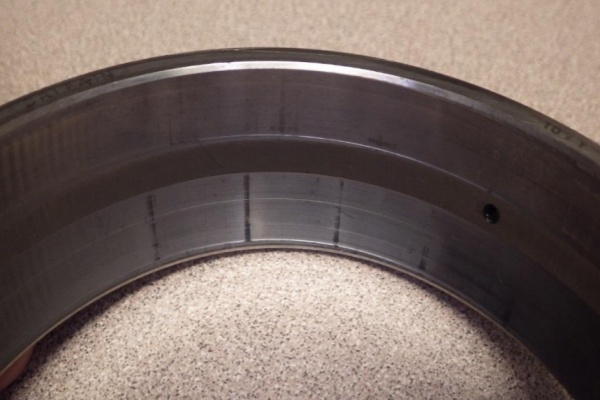
Comparison: True Brinelling vs. False Brinelling
Diagnostic Chart for Maintenance Engineers
| Feature | True Brinelling | False Brinelling |
|---|---|---|
| Primary Mechanism | Plastic Deformation (Denting) | Fretting Wear / Corrosion |
| Operational State | Occurs via Impact or Overload (Instant) | Occurs when Stationary (Vibration) |
| Visual Texture | Original grinding marks visible inside the dent | Grinding marks worn away; rough surface |
| Color Indicator | Shiny depression (Metal color) | Reddish-brown (Oxidized iron/Rust) |
| Root Cause | Improper installation (Hammering) or Static Overload | Transport vibration, standby oscillation |
| Common Industries Affected | Heavy machinery, automotive assembly, construction equipment | Wind turbines, rail transport, conveyor systems in storage |
How to Prevent These Failures (TFL Bearing Recommendations)
At TFL Bearing, we believe that the best bearing is one you don’t have to replace constantly. Here is how to stop these issues before they start:
Preventing True Brinelling
-
-
Ditch the Hammer: Never strike a bearing directly. The #1 cause of True Brinelling is installation error. Always use professional induction heaters or fitting tool kits to mount bearings evenly without shock load.
-
Check Static Load Ratings (Cor): Ensure the chosen bearing has a Basic Static Load Rating (Cor) high enough to handle your application’s peak shock loads.
-
TFL Insight: TFL bearings are manufactured with vacuum-degassed high-purity steel and undergo advanced heat treatment. This maximizes the Cor value, giving our bearings superior resistance to sudden impacts compared to standard grades.
-
-
Preventing False Brinelling
-
Secure During Transport:
-
For Machinery: If shipping motors or gearboxes with bearings installed, lock the shafts to prevent micro-movements.
-
For Loose Bearings: Ensure bearings are packed flat (horizontally) with high-density vibration-dampening dunnage. Avoid stacking heavy boxes too high, which creates pressure on the bottom units.
-
-
Rotate Idle Equipment: For backup pumps or fans, implement a maintenance schedule to rotate the shafts periodically (e.g., once a week). This redistributes the grease and changes the contact point of the rollers.
-
Upgrade Lubrication: Use greases with specific anti-fretting additives or lighter consistency (NLGI 1 vs. 2) that can flow back into the contact zone easier during small movements.
Conclusion: Force vs. Vibration
Distinguishing between True Brinelling and False Brinelling is the first step toward a more reliable operation. Remember the golden rule:
-
True Brinelling is a Force problem (Impact/Overload).
-
False Brinelling is a Motion problem (Vibration/Lubrication).
As a global bearing manufacturer, TFL Bearing goes beyond just selling steel. We provide the engineering support, proper packaging standards, and high-load capacity products you need to solve these challenges permanently.
Stop Guessing. Let Us Diagnose Your Failure for Free.
Contact TFL Bearing‘s engineering team today for a free consultation, or browse our catalog of high-load, heavy-duty bearings designed to withstand the toughest industrial conditions. Our engineering team will analyze your damaged bearing and provide a free diagnosis within 48 hours. We will then recommend a TFL replacement featuring our advanced heat-treated, vacuum-degassed steel —specifically engineered to maximize Static Load Ratings (Cor) and prevent this damage from happening again.
FAQ: Common Questions from Our Customers
Q: Can False Brinelling occur during ocean shipping?
A: Yes. The low-frequency vibration of a ship’s engine over weeks of transit is a major cause of false brinelling.
-
For Machinery: We recommend shaft locking mechanisms.
-
For Loose Bearings: TFL recommends (and uses) high-density vibration-dampening packaging to prevent rollers from chattering against the raceway during ocean freight.
Q: Is Brinelling repairable?
A: Generally, no. Once the raceway surface is damaged—whether by denting (True) or fretting wear (False)—the smooth running of the bearing is compromised. Attempting to polish it out usually alters the internal clearance geometry. Continued use will lead to excessive noise, heat, and eventual spalling (catastrophic failure). Replacement is always recommended.
Q: What does Brinelling sound like?
A: Both types often produce a distinct, rhythmic noise.
-
Low Speed: You may hear a “clicking” or “clunking” sound as the rolling elements pass over the damaged spots.
-
High Speed: This often blends into a loud, high-pitched “whine” or “growl” accompanied by increased vibration.
Q: Is it False Brinelling or Electrical Erosion (Fluting)?
A: This is a common confusion, as both create rhythmic patterns on the raceway. Here is the rule of thumb:
-
Check the Spacing: False Brinelling marks align exactly with the spacing of the rolling elements. Electrical Fluting (caused by stray current arcing) usually creates a tight “washboard” pattern where the lines are much closer together than the rollers.
-
Check the Color: False Brinelling is reddish-brown (rust). Electrical erosion often appears as gray or black lines, and under magnification, you may see tiny molten pits (micro-craters) from the electrical arcs.
-
Prevention Tip: Unlike mechanical brinelling, standard steel bearings cannot resist this current. The only permanent fix for VFD-driven motors is to block the path. ➜ View the Solution: Check our [Insulated Bearings Specification Guide (VL0241/VL2071)] to find a drop-in replacement that stops fluting immediately.