Comparison of N, NU, NJ, NF, NUP Type Cylindrical Roller Bearings

Introduction

Cylindrical roller bearings have a large load capacity and mainly bear radial loads. Its structure is simple, including cylindrical rolling elements, inner rings, outer rings, and retainers. Single-row cylindrical roller bearings are the most basic type. Its different structures are reflected in the different designs of the ribs. Common basic cylindrical roller bearing types include N NU, NJ NF, and NUP. This article will introduce the characteristics and applications of these types to help you further understand.
The following chart is a simple summary of the comparison of the different rib types for cylindrical roller bearings.
TypeInner RingOuter RingAxial DisplacementAxial LoadTypical Role(Floating)
NDouble RibNo RibLargeNoneNon-Locating (Floating)
NUNo RibDouble RibLargeNoneNon-Locating (Floating)
NJDouble RibSingle RibLimitedSmall One-WaySemi-Locating
NFDouble RibSingle RibPoorLarge One-WaySemi-Locating (Less Common)
NUPSingle Rib + Loose RingDouble RibRestrictedTwo-WayLocating (Fixed)
If you still need more detailed information, please continue to read the following parts.

N Type Cylindrical Roller Bearings

Description
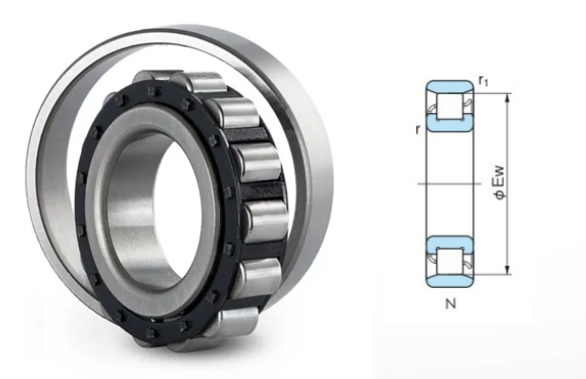
The outer ring of N cylindrical roller bearings has no ribs, and the inner ring has ribs on both sides. The N type design allows the shaft to move relative to the bearing seat in both axial directions. The inner ring can move axially relative to the outer ring, which is very suitable for applications where thermal expansion occurs. This type is suitable as a free-end bearing. However, it cannot bear any thrust load.
An image of a single row cylindrical roller bearing (N type)
n-type-cylindrical-roller-bearing

Application

The N Type Cylindrical Roller Bearings are commonly used in electric motors, pumps, and compressors.

NU Type Cylindrical Roller Bearings

Description
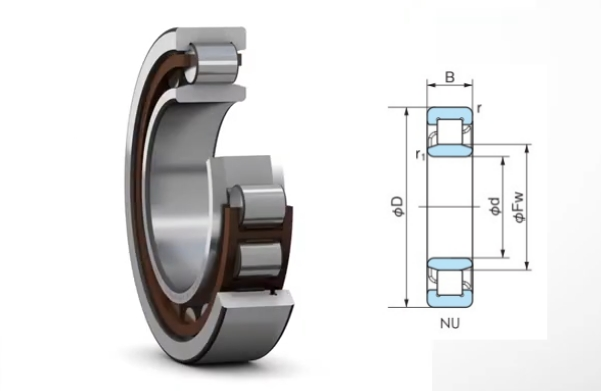
The NU cylindrical roller bearing has ribs on both sides of the outer ring and no ribs on the inner ring. The NU type allows displacement of the shaft relative to the bearing seat in both axial directions. This kind of structure is suitable for use as a free-end bearing. It can accommodate expansion and contraction. It can only carry radial loads.
An image of a single row cylindrical roller bearing with one flange (NU type)
nu-type-cylindrical-roller-bearing

Application

Similar to the N type, the NU type bearing is also often used as a free-end support in situations where the shaft is elongated due to heat or the installation error is large. It is suitable for high-speed occasions, such as high-speed motors and compressors.

NJ Type Cylindrical Roller Bearings

Description
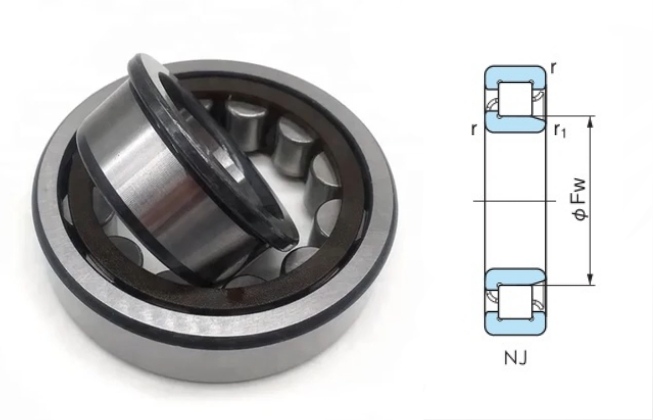
The NJ cylindrical roller bearing has two ribs on the outer ring and one rib on the inner ring. The inner ring of the NJ bearing has a rib on one side and can be separated from the bearing assembly on one side. The design is capable of withstanding limited axial loads in a single direction.
An image of a single row cylindrical roller bearing with two flanges (NJ type)
NJ-type-cylindrical-roller-bearing

Application

The NJ bearings are widely used in machine tools, turbines and industrial fans where a certain amount of axial load is required.

NF Type Cylindrical Roller Bearings

Description
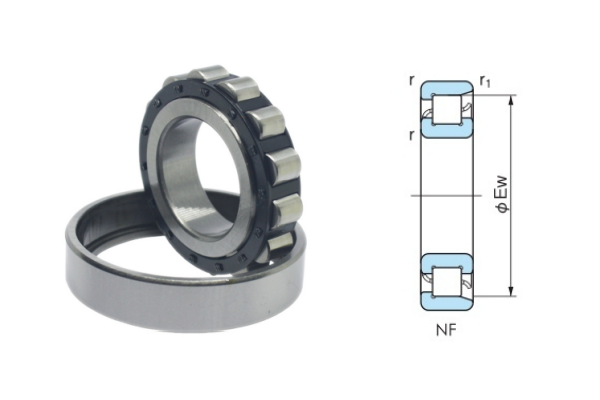
The NF cylindrical roller bearing has ribs on one side of its outer ring and ribs on both sides of its inner ring. It is designed to withstand a certain amount of unidirectional axial load. This type of structure is suitable for use as a one-way axial positioning bearing.
NF type cylindrical roller bearing for heavy-duty applications. 
nf-type-cylindrical-roller-bearing

Application

Due to its high radial load capacity, NF bearings are often used in equipment that bears large loads, such as rolling mills and heavy machinery.

NUP Type Cylindrical Roller Bearings

Description
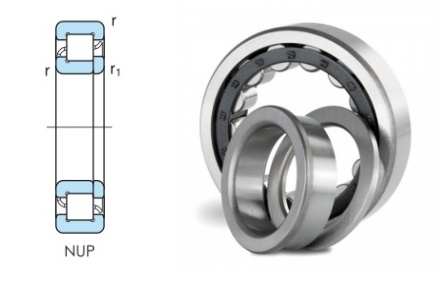
NUP cylindrical roller bearings have ribs on both sides of the outer ring, a (fixed) single rib on one side of the inner ring, and a detachable flat ring on the other side. They can withstand a certain amount of bidirectional axial load. This type of structural bearing can limit the displacement of the shaft relative to the bearing seat in both axial directions. Therefore, it is suitable for use as a fixed-end bearing.
An image of a single row cylindrical roller bearing with two flanges and a filling slot (NUP type)
nup-type-cylindrical-roller-bearing

Application

NUP bearings can bear bidirectional axial loads, so they can be used in situations where bidirectional axial positioning is required. They are often used in high-precision machine tools, precision instruments and other equipment that have high requirements for axial positioning.

Conclusion

Understanding the rib configurations of N, NU, NJ, NF, and NUP bearings is critical for preventing axial overload and ensuring proper shaft expansion.

  • NU & N: Best for “floating” positions (Zero axial load).

  • NJ & NUP: Essential for “fixing” positions (Axial locating).

Don’t let a wrong selection cause downtime. TFL Bearing stocks a full range of these series in premium steel and brass cages. [Browse Our Cylindrical Roller Catalog] or [Contact Our Engineers] for a quick cross-reference and quote.

FAQs

How to choose the right type of cylindrical roller bearing?

The choice depends entirely on the axial load and mounting requirements:

  • Radial Load Only + Free Expansion: Choose NU or N type (Floating bearing).

  • Radial + One-Direction Axial Load: Choose NJ type.

  • Radial + Two-Direction Axial Load (Locating): Choose NUP type (or NJ + HJ ring).

Which bearing type is suitable for high axial loads?

NJ and NUP types can handle light to moderate axial loads due to their rib design. However, they are NOT designed for heavy axial thrust.
For applications with high axial loads, we recommend using Tapered Roller Bearings or Angular Contact Ball Bearings. Using a cylindrical roller for heavy thrust can lead to rib scoring and premature failure.

Are the N, NU, NJ, NF, and NUP bearings interchangeable?

Yes, as long as they share the same ISO dimension series (e.g., a NU 310 has the same boundary dimensions as a NJ 310). This means you can often switch from an NU to an NJ if your application requires axial locating, provided the housing and shaft fit allows it. However, always check the internal clearance (C3, C4) before swapping.

How are N and NU type bearings selected in practical applications? What precautions should be taken?

While both handle shaft expansion, the NU type is significantly more popular because its outer ring (with ribs) stays in the housing, while the inner ring (without ribs) can be separated. This makes mounting and dismounting much easier, especially in interference fits for electric motors and gearboxes.

What are NN and NNU bearings?

These are Double Row Cylindrical Roller Bearings. They offer extremely high radial rigidity and load capacity, making them the standard choice for machine tool spindles and steel rolling mills. Unlike single-row types, they have a lower cross-section and minimize deformation under load.